

Grab-and-Go Is Booming, Is Your Packaging Built for It?
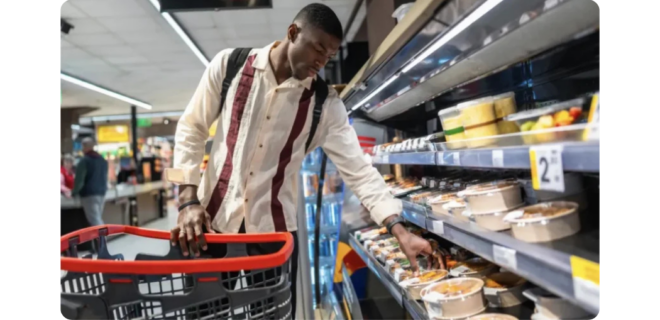
The grab-and-go section barely existed in most stores a couple of decades ago. Now it’s prime real estate. Refrigerated cases full of single-serve meals, protein boxes, cut fruit, wraps, overnight oats, little containers of hummus with the pretzels tucked in the lid. People want food they can buy in one motion and eat without any prep and retailers have noticed. If you make food, there’s a lot of room to grow here.
However, this format is deceptively hard to get right and the reason is that a grab-and-go package has to do several jobs that don’t naturally cooperate.
Start with the most basic one: people eat straight out of it. There’s no plate, no bowl, no serving step. That changes everything about the design. The container has to open easily, hold a portion that makes sense for one person, sometimes work with a fork that’s tucked inside, and in a lot of cases reseal so someone can eat half at their desk and finish the rest later. None of that matters for food you cook at home, but for this category it’s the whole experience.
Then there’s where the food actually gets eaten, which is usually nowhere near a kitchen. A car, a break room, a park bench, a train. That means the package often sits at room temperature, or warmer, for a good stretch before anyone opens it. For chilled items that’s not a small thing. It’s a real food-safety question, and the packaging has to help manage it rather than ignore it. Getting temperature performance into a format that also needs to be light, cheap, and portable is genuinely tricky.
Cost and volume make it harder still. Grab-and-go runs on thin margins and big quantities. A packaging choice that works beautifully but adds a few cents per unit can wipe out the economics when you’re producing hundreds of thousands of them. So every gram of material and every bit of complexity gets scrutinized in a way it wouldn’t for a premium product.
And then there’s sustainability, which lands especially hard on this category. Single-serve, single-use packaging is exactly the kind of thing shoppers feel guilty about and regulators are starting to target. Producers are under real pressure to cut down on material and move toward recyclable or compostable options, all without giving up the protection, the shelf appeal, or the price point. That’s a tall order, and it’s one of the biggest open challenges in that space right now.
Here’s the part that trips people up. Each of these demands is manageable on its own. The trouble is that they pull against each other. Build in temperature protection and you may add cost and material, which fights your sustainability goal. Go lighter and greener and you may give up durability or clarity. Make it rugged enough to survive a backpack and you might lose the clean look that made someone grab it. There’s no off-the-shelf answer that balances all of it, because the right balance depends entirely on what the product is and how it’s actually eaten. A cold grain bowl, a warm handheld pastry, and a smoothie each want something different.
That balancing act is what we do at Teinnovations. We look at the specific product, the way it travels, the temperature it needs to hold, the margin it has to hit, and the sustainability targets you’re working toward, and we build a packaging solution that holds all of those in tension without dropping any of them. Grab-and-go is only getting bigger. Your packaging should be built for the way it’s really used. Bring us the problem. We’ll bring the solution.
< Back To News